Showing posts with label complex. Show all posts

18 October 2021

[45] Some Problems With Non-Iterative/Non-Nuclear/Linear Structures

Doran (2021):


Blogger Comments:

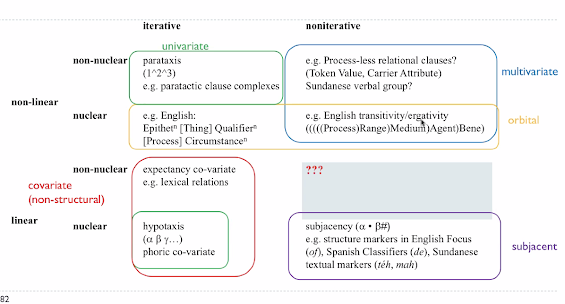
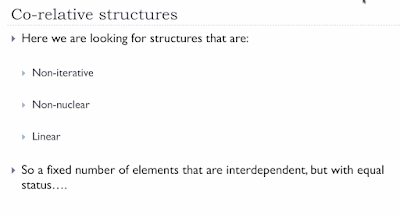
To be clear, here Doran is looking for structures that fit the combination of factors that specify the last unfilled cell of his table.

Ignoring all the previously noted problems with the factors themselves, by the logic of the table, Doran should be looking for a structure that is:

  1. the non-nuclear counterpart of subjacency duplexes, and
  2. the non-iterative counterpart of covariate lexical relations, and
  3. the linear counterpart of relational clauses without a Process.

He tentatively suggests:

  • correlative conjunctions in English, or
  • clitic doubling in Spanish, or
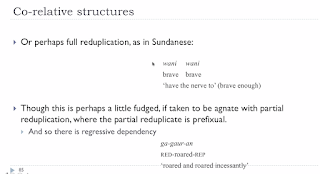
  • full reduplication in Sundanese.

There is no argument as to how these satisfy the three requirements above, and in the case of correlative conjunctions — which do not, in themselves, constitute a structure — the structure that they mark is a paratactic clause complex, a univariate structure, which, in terms of Doran's factors is:

  • iterative rather than non-iterative, and
  • non-linear rather than linear.

11 October 2021

[38] Problems With Lexical Relations As Structures

Doran (2021):

Blogger Comments:

[1] To be clear, 'lexical relations' refers to Martin's (1992) system of IDEATION, which is his rebranding of his misunderstandings of lexical cohesion (Halliday & Hasan 1976), relocated from textual lexicogrammar to experiential discourse semantics. Evidence here.

Importantly, from the perspective of SFL Theory, these cohesive relations are not structures, either in the sense of a unit as a configuration of elements, or in the sense of a complex of units.

[2] To be clear, Doran's second point again confuses the general notion of iteration (repetition) with iterative as a specific type of structure that realises the logical metafunction.

[3] To be clear, Doran's third point mistakes meronymic relations for interdependency relations, and mistakes lexical items for elements of structure.

[4] To be clear, Doran's fourth and fifth points are untenable, even in his own model. On the one hand, if these were relations of dependency, the relation would be hypotaxis, which corresponds, in terms of Doran's resources, to Martin's orbital (mono-nuclear) structure. So, on this basis, there should be a nucleus to which everything else relates.

On the other hand, given that these are part-whole relations, Doran could just as easily make the argument, from his own perspective, that the whole constitutes the nucleus, with the parts as satellites, though this would undermine the point he is trying to make.

And, in the final line, Doran shows again that he does not understand that 'interdependency' refers to taxis (parataxis and hypotaxis). 

04 October 2021

[31] Some Problems With Doran's Notion Of Nuclear Dependency

Doran (2021):


Blogger Comments:

[1] To be clear, before Doran, Halliday (1985: 167) identified the Thing as 'the semantic core of the nominal group'.

[2] To be clear, in SFL Theory, in the experiential structure of the nominal group, all the other elements have 'the function of characterising the Thing' (Halliday 1985: 167). The Thing specifies the class of thing, and the other elements specify some category of membership within this class (Halliday 1985: 160).

[3] To be clear, the first nominal group is the artificial invention of a non-native speaker of English, and the second is a reworking of it by Doran. To the extent that the Epithets can be swapped in this unnatural nominal group, it is because they vary little in terms of 'permanence'. Halliday (1985: 166):

By and large, the more permanent the attribute of a Thing, the less likely it is to identify it in a particular context. So we proceed with the very impermanent, quantitative characterisation that is nearest to a Deictic, e.g. three in three balls; through various qualitative features such as new in new ball; and end up with the most permanent, the assignment to a class, e.g. tennis ballWithin the qualitative characteristics, if more than one is specified there is, again, a tendency to more from the less permanent to the more permanent; e.g. a new red ball rather than a red new ball.

On the other hand, the reason why the prepositional phrases serving as Qualifier can be reversed is because they form a paratactic complex, as shown by the fact that either can be omitted.

[4] To be clear, a structure is a structure of a whole unit. Incongruously, Doran here proposes different structures obtaining between different elements within the structure of the same unit. That is, he proposes one structure for the relation between Epithet and Thing, and between Qualifier and Thing, but another structure with regard to the Classifier. (see the next post).

[5] To be clear, Doran's notion of nuclear dependency misconstrues the elements that characterise the Thing, Epithet and Qualifier, as elements that are dependent on the Thing — simply because they relate to the Thing. This misunderstanding derives from confusing interdependency (hypotaxis) with the 'dependency construct' in Halliday (1979):


That is, Doran's notion of nuclear dependency for (portions of) the nominal group is equivalent to a tree structure with Epithets and Qualifiers as nodes branching from the Thing as root node.
22 September 2021

[19] Martin's Solution To The Non-Problem Of Structure Marker 'Of'

Doran (2021):

Blogger Comments:

[1] As previously observed, the logical structure of this nominal group is:

[2] To be clear, Martin's (quite bizarre) solution to this non-existent problem is to misconstrue the numeral and noun as forming a complex with the preposition of the embedded prepositional phrase:


As previously explained, two litres and of do not form a unit complex because
  • of is just one of two constituents of the prepositional phrase of water, and
  • there is no logico-semantic relation of expansion or projection between two litres and of.

[3] To be clear, Martin's proposed "complex" is not a complex, and so it is not an iterative structure. On the other hand, if it were a complex, it would be an iterative structure, because all complexes are iterative structures, regardless of the number of units involved.

21 September 2021

[18] Misrepresenting The SFL Analysis Of The Structure Marker 'Of'

Doran (2021):

Blogger Comments:

[1] To be clear, in SFL Theory, the structure marker of is accounted for in terms of the univariate logical structure of the nominal group where it is construed as a constituent of the rankshifted prepositional phrase serving as Postmodifier


[2] To be clear, in SFL Theory, the structure marker of is not dependent on two litres (which is only an embedded nominal group in the multivariate experiential analysis). There are two main reasons for this:
  • interdependency relations obtain between units in unit complexes, and two litres and of are not two units that form a unit complex — i.e. two litres and of do not form a nominal group complex, or a preposition group complex — since of is a constituent of the prepositional phrase of water;
  • interdependency relations involve the logico-semantic relations of expansion and projection, and there is no such relation between two litres and of.

[3] To be clear, the reason why "we can't have a nominal group of water" is that of water is a prepositional phrase, not a nominal group.

[4] To be clear, the question of whether of can or cannot "re-iterate" only arises from the misunderstandings identified in [1], [2] and [3] above.

[5] To be clear, in this instance, the structure marker of relates the nominals two litres and water and it is modelled in SFL Theory as a constituent of the prepositional phrase that serves as Postmodifier in the univariate structure of the nominal group.

It will be seen in the following post that Martin's proposed solution to this non-existent problem does not in fact relate two litres to the rest of the nominal group, since it only relates two litres to of, and does so by misconstruing of as dependent on two litres in a two-unit complex; see [2] above.

10 September 2021

[7] Misrepresenting "The Conflation Of Distinct Tiers Of Structure" As SFL Theory

Doran (2021):


Blogger Comments:

[1] These bare assertions are very misleading indeed, because on the one hand, there is no indeterminacy ("fuzziness") here — see the previous post — and on the other hand, there is no structure conflation in SFL Theory. As a consequence:

  • this non-existent indeterminacy is not "often described in terms of conflation of distinct tiers of structure",
  • conflation does not "work well in emphasising that there are tensions occurring between different strands of meaning",
  • conflation does not "give us a tool for understanding how this non-existent fuzziness works, or the parameters of variation of this non-existent fuzziness",
  • conflation does not "give us an explanation of why a structure occurs", and
  • conflation is not relevant to "a description of what the structure is".

[2] And, to be clear, the reason why structure markers are "simply left out of any structural description" is simply that they are not units in unit complexes.

06 September 2021

[3] Halliday (1979) On Structure Types

Doran (2021):


Blogger Comments:

The following summary, from the same early paper, will also be useful for later discussions. Halliday (2002 [1979]: 217):
In English, experiential options tend to generate constituent-like structures, actually constellations of elements such as can be fairly easily represented in constituency terms. Interpersonal options generate prosodic structures, extending over long stretches (for example intonation contours), which are much less constituent-like. Textual options generate culminative structures, elements occurring at the boundaries of significant units, and give a kind of periodicity to the text, which is part of what we recognise as “texture”. Logical options generate recursive structures, paratactic and hypotactic, which differ from all the other three in that they generate complexes — clause complex, group complex, word complex – and not simple units.