Showing posts with label clause. Show all posts

18 October 2021

[45] Some Problems With Non-Iterative/Non-Nuclear/Linear Structures

Doran (2021):


Blogger Comments:

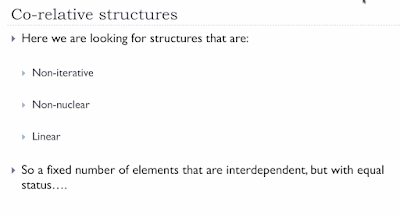
To be clear, here Doran is looking for structures that fit the combination of factors that specify the last unfilled cell of his table.
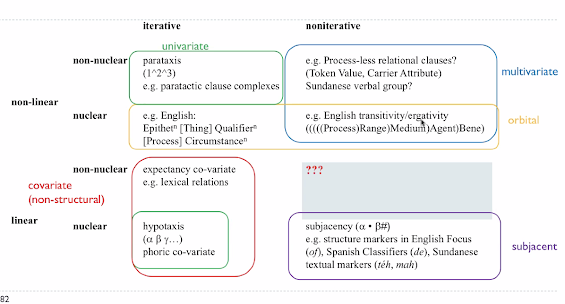
Ignoring all the previously noted problems with the factors themselves, by the logic of the table, Doran should be looking for a structure that is:

  1. the non-nuclear counterpart of subjacency duplexes, and
  2. the non-iterative counterpart of covariate lexical relations, and
  3. the linear counterpart of relational clauses without a Process.

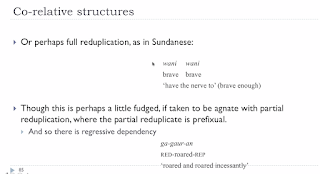
He tentatively suggests:

  • correlative conjunctions in English, or
  • clitic doubling in Spanish, or
  • full reduplication in Sundanese.

There is no argument as to how these satisfy the three requirements above, and in the case of correlative conjunctions — which do not, in themselves, constitute a structure — the structure that they mark is a paratactic clause complex, a univariate structure, which, in terms of Doran's factors is:

  • iterative rather than non-iterative, and
  • non-linear rather than linear.

17 October 2021

[44] The Problem With Non-Linear/Non-Nuclear/Non-Iterative Structures

Doran (2021):


Blogger Comments:

To be clear, the additional claim here is that the previously top-right empty cell — the intersection of the factors [non-linear, non-nuclear, non-iterative] — is exemplified by relational clauses without a Process and the Sundanese verbal group.

[1] With regard to the relational clauses, this is inconsistent even within Doran's own model, because these clauses do have a nucleus, since the nucleus comprises the Medium as well as the Process, and these clauses do have a Medium: Identified in identifying clauses, and Carrier in attributive clauses.

[2] With regard to the Sundanese verbal group, the categorisation rests on Doran's claim that the Event function is optional, and confusions such as looking for dependency (logical structure) in an experiential analysis that is not consistent with SFL Theory:

14 October 2021

[41] The Variations In Structure Afforded By Doran's 3 Factors

Doran (2021):


Blogger Comments:

[1] To be clear, this table presents the four cells of the preceding table as 'iterative'.

In the case of the top cell of the 'iterative' column, [non-linear, non-nuclear], this is consistent with SFL Theory, since parataxis is one type of interdependency relation in iterative structures of the logical metafunction.

In the case of the second cell of the 'iterative' column, [non-linear, nuclear], this is not consistent with SFL Theory, because, as previously explained, Doran's 'iteration' confuses multiple occurrences of (experiential) elements — Epithets, Qualifiers, circumstances — with iterative structures of the logical metafunction.

In the case of the third cell of the 'iterative' column, [linear, non-nuclear], this is not consistent with SFL Theory, not least because 'covariate' is not a type of structure, as Lemke (1989) acknowledges.

In the case of the bottom cell of the 'iterative' column, [linear, nuclear], this would be consistent with SFL Theory, if hypotaxis had been what Doran argued for, since hypotaxis is one type of interdependency relation in iterative structures of the logical metafunction. However, Doran's argument for this classification was actually concerned with the relation between Classifiers in the experiential structure of the nominal group.

This bottom cell also features a category for which there has been no argumentation, 'phoric covariate'. Again, the problem here is that 'covariate' is not a type of structure, and so not iterative in a structural sense.

[2] The 'non-iterative' column of the table has only two of its four cells filled.

The upper cell, [non-linear, nuclear], is consistent with SFL Theory in as much as experiential structures are multivariate and so non-iterative.

However, the lower cell, [linear, nuclear], identifies the subjacency duplex. On the one hand, there has been no argument for classifying this structure as linear, and on the other hand, the subjacency duplex is not a structure, not least because it is based on misunderstandings of constituency. See, for example, the previous posts:

02 October 2021

[29] Misconstruing Orbital Structure As Not Multivariate

Doran (2021):


Blogger Comments:

[1] To be clear, here Doran misconstrues Martin's two different ways of representing one type of structure — the multivariate structure of the experiential metafunction — as two different types of structure, treating the tree schema representation as multivariate, and the co-tangential ellipses representation as orbital (but not multivariate).

The reason why both are representations of multivariate structure is because both represent the same elements of structure and both represent 'a configuration of elements each having a distinct function with respect to the whole' (Halliday & Matthiessen 2014: 390).

[2] To be clear, there are problems with both representations in Martin's Figure 7. Firstly, contrā Doran, the co-tangential ellipses representation does not represent an orbital structure, because it does not represent the non-nuclear elements as satellites of a nucleus.

Secondly, the tree schema representation misunderstands grammatical constituency. In SFL theory, grammatical constituency is modelled as a rank scale of forms, such that clauses consist of groups ± phrases, which consist of words, which consist of morphemes.

So, in Figure 7, the whole is the clause, the parts of the clause are the groups that constitute the clause. The structure, on the other hand, is the relationships between experiential functions assigned to the syntagm of groups.

The relation between a whole and its parts is composition (extension), whereas the relation between function and form is realisation (elaboration + identity).

01 October 2021

[28] Martin's Orbital Model As Univariate Representation Of A Multivariate Structure

Doran (2021):


Blogger Comments:

To be clear, Martin's orbital interpretation is a univariate representation of a multivariate structure. The structure is multivariate because it is 'a configuration of elements each having a distinct function with respect to the whole' (Halliday & Matthiessen 2014: 390): Process, Medium, Agent, Location. The representation is univariate because it misconstrues the structure as a hypotactic relation (dominant nucleus vs dependent satellites).

30 September 2021

[27] Misrepresenting Halliday's Explanation of Ergative Nuclearity As Doran's Argument For Martin's Orbital Structure Model

Doran (2021):

Blogger Comments:

[1] This is misleading in two ways. Firstly, Doran falsely presents Halliday's ideas as if they were his own. Halliday (1985: 146-7):
Except in the special case of the medio–receptive voice, the Medium is obligatory in all processes; and it is the only element that is, other than the process itself. … The Medium is also the only element that is never introduced into the clause by means of a preposition (again with the same exception of medio–receptives); … The Process and the Medium together form the nucleus of an English clause; and this nucleus then determines the range of options that are available to the rest of the clause.
Secondly, Doran falsely presents Halliday's description of nuclearity — a nonlinear interpretation of the ergative model of transitivity — as if it were support for Martin's orbital model of structure.

Moreover, Doran shows no evidence of being aware of the elaboration of this model in Halliday & Matthiessen (1999: 165-176) as 'degree of participation' and 'degree of involvement'.

[2] Less importantly, contrā Doran, circumstances can occur as Subject, as demonstrated by circumstantial identifying relational clauses; Halliday (1985: 121):

29 September 2021

[26] Problems With Martin's Orbital Model Of Experiential Structure

Doran (2021):


Blogger Comments:

[1] To be clear, Martin (1996) misunderstands Halliday (1985, 1994) and Matthiessen (1995) by misconstruing the (multivariate) experiential structure of a clause as a (univariate) logical structure in which the Process and Medium constitute the dominant element (nucleus), with the Agent and Location as dependent (satellites):

In SFL Theory, interdependency relations obtain between units in unit complexes, not between elements in a unit.

[2] To be clear, the model in Martin (1996) is not only inconsistent with the model in Martin (1992: 319), which preceded Matthiessen (1995):

but also with the model in Martin & Rose (2007: 95), which followed both Matthiessen (1995) and Martin (1996):

27 September 2021

[24] The Nuclear Model Of Clause Transitivity

Doran (2021):


Blogger Comments:

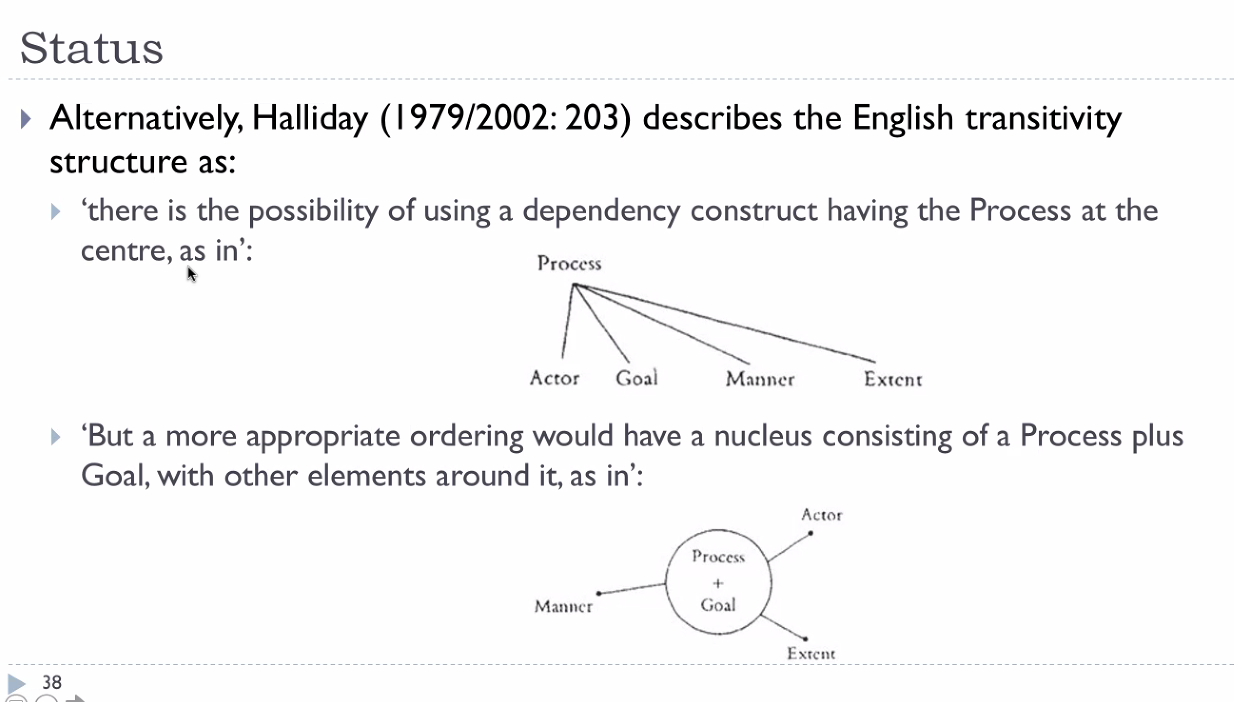
[1] To be clear, in this early, first exploration of structure types by metafunction, Halliday (1979) considered three non-linear representations of experiential structure (in addition to the linear):

[2] Importantly, 'dependency construct' refers to a tree structure schema, not to interdependency in the sense of tactic relations between units. It will be seen in future posts that Doran confuses the two.

[3] To be clear, the notion of a clause nucleus was taken up in Halliday (1985: 147) — and every edition of IFG since — but applied to the ergative model, not the transitive model, of clause transitivity:

The Process and the Medium together form the nucleus of an English clause; and this nucleus then determines the range of options that are available to the rest of the clause. Thus the nucleus ‘tear + cloth’ represents a small semantic field which may be realised as a clause either alone or in combination with other participant or circumstantial functions.
Matthiessen (1995: 197) then developed this as a cline of nuclearity/peripherality of involvement:
which was then greatly elaborated in Halliday & Matthiessen (1999: 165-176) as degree of participation and degree of involvement, and used to relate participants and circumstances in terms of logico-semantic relations:


26 September 2021

[23] Misrepresenting SFL Theory On Hypotaxis

Doran (2021):


Blogger Comments:

[1] Doran's first point is misleading, because it is untrue. In SFL Theory, hypotaxis ("status differences") is a relation in iterative structures of the logical metafunction only. The source of Doran's confusion, as will be seen, is the model of structure in Martin (1996):

which unwittingly misconstrues the distinction between experiential and logical structure as the distinction between hypotaxis (the unequal status of nucleus and satellite) and parataxis (the equal status of multiple nuclei).

[2] As was the case with the multivariate vs univariate distinction, Doran again begins his argument on experiential structure with Halliday's first statement on the matter, instead of later revised theorising.

[3] To be clear, what Doran refers to as a 'flat' structure, Halliday (1979) terms a linear structure.

18 September 2021

[15] Misconstruing "Iterated Elements" As Iterative Structure

Doran (2021):


Blogger Comments:

[1] To be clear, Doran's claim here is that a multivariate structure with multiple occurrences of a specific element is inconsistent with the notion of a multivariate structure, because Halliday (1965) stipulated that the elements of a multivariate structure occur only once. 

However, Halliday (1965) was his very first paper distinguishing multivariate and univariate structures, written at the time of Scale & Category Grammar, before the emergence of Systemic Functional Grammar. It also included the similarly mistaken claim that Modifier°Head structures are multivariate, rather than univariate. No paper in the 56 years since Halliday (1965) has claimed that the elements of a multivariate structure occur only once (with the sole exception of the current work of Doran and Martin).

However, what is truly astonishing here is Doran's assumption that Halliday — unlike Doran — would fail to notice that such structures contradict the notion of multivariate structure ascribed to him by Doran.

[2] To be clear, the data that Doran presents as evidence of his claim are artificial constructions, rather than attested examples in natural texts. But, in any case, none of the "iterations" constitutes an iterative structure, since iterative structures are unit complexes, formed out of logico-semantic relations, such as group complexes or clause complexes. That is, the three Epithets do form an "Epithet complex", the two Qualifiers do not form a "Qualifier complex" and the three Locations do not form a "Location complex".

[3] To be clear, the clause example does not support Doran's case, even in Doran's own terms, because it actually features one Location — not three — realised by a (textually motivated) discontinuous elaborating paratactic prepositional phrase complex:


Compare the textually agnate clause:


and the agnate clause that deploys embedding instead: